 Available in US
Content
Why a Marketing Phrase Is Worth Reading Twice
“Best Odds Guaranteed” is the most promoted promotional phrase on UK sportsbooks I’ve worked with, and almost certainly the most frequently misunderstood. Punters see the badge, assume they’re getting a free upgrade, and stake without reading the small print. The small print is where most of the value of the promise either lives or dies.
The promise reads simply: if the official starting price is bigger than the price you took, you get paid out at the bigger price. That sounds unambiguous until you realise the phrase “official starting price” has at least three different definitions across UK operators, and the markets it covers vary widely. The promotion lives or dies on its terms — and the terms are buried.
I’m not against BOG as a concept. Used correctly on the right markets, it adds genuine expected value to a betting workflow. Used as a green light to stake recreationally, it disappoints quietly and consistently.
How BOG Pays Out Mechanically
The mechanics are worth understanding precisely because the marketing copy obscures them. BOG settlement works as follows: when you place a bet at a stated price, the sportsbook records both that price and the time of the bet. At the official market close — usually the start of play in cricket — the sportsbook compares your taken price to the official starting price. If the SP is longer than your taken price, the winning bet is recalculated at the SP and the difference is paid as a top-up.
Critical detail: the top-up only applies if the bet wins. If your bet loses, BOG doesn’t refund anything. The promise is therefore an asymmetric upgrade — it improves your winning returns without affecting your losing returns. That’s a structural expected-value uplift, but a small one in absolute terms.
The size of the typical top-up is also smaller than punters expect. Most price drifts between bet placement and SP are modest. A bet taken at 5/2 might settle at SP of 11/4 — a small uplift in fractional terms but a real one in monetary terms over many bets. Genuine large price drifts (where SP is 5/1 against a taken price of 2/1) happen on a minority of bets, typically when news breaks late.
The top-up itself can be paid as cash to your account balance, as a free-bet token, or sometimes as a hybrid arrangement. Cash is the only version that’s worth real money to a serious punter — free-bet tokens have lower effective realisation value because the stake portion of the free bet doesn’t return on winning bets.
Cricket Markets BOG Usually Excludes
The cricket-specific exclusions are where most punters get tripped up. The promotion typically applies to a narrower set of markets than the headline copy implies, and the exclusions matter operationally.

In-play cricket markets are almost universally excluded from BOG at UK sportsbooks. The reason is structural: in-play markets don’t have a single “starting price” because they’re priced continuously throughout the match. BOG depends on the existence of an official SP at market close, and live markets don’t produce one.
Exotic cricket markets are also routinely excluded. Top batter, top bowler, method of dismissal, partnership totals — these are typically outside BOG even though they’re on the same sportsbook. The exclusion is operational rather than promotional: pricing engines on exotic markets don’t anchor to a clean SP, so the operator can’t reliably compute the top-up.
What’s usually included: pre-match match-winner, pre-match outright tournament markets, and team-total over/under markets settled on first innings score. These are the markets where SP can be computed cleanly because they have a well-defined market close at the start of the relevant innings or match.
Bet builders, accumulators and request-a-bet products are mixed. Some operators apply BOG to the qualifying legs within a builder; others exclude builders entirely. The slip’s specific terms are the only authoritative source — the headline promotional badge alone doesn’t tell you which version applies.
How UK Sportsbooks Differ in Their BOG Terms
Across the major UK sportsbooks, the BOG terms vary in ways that materially affect expected value. I keep notes on the differences because they shift my own staking decisions on borderline value plays.
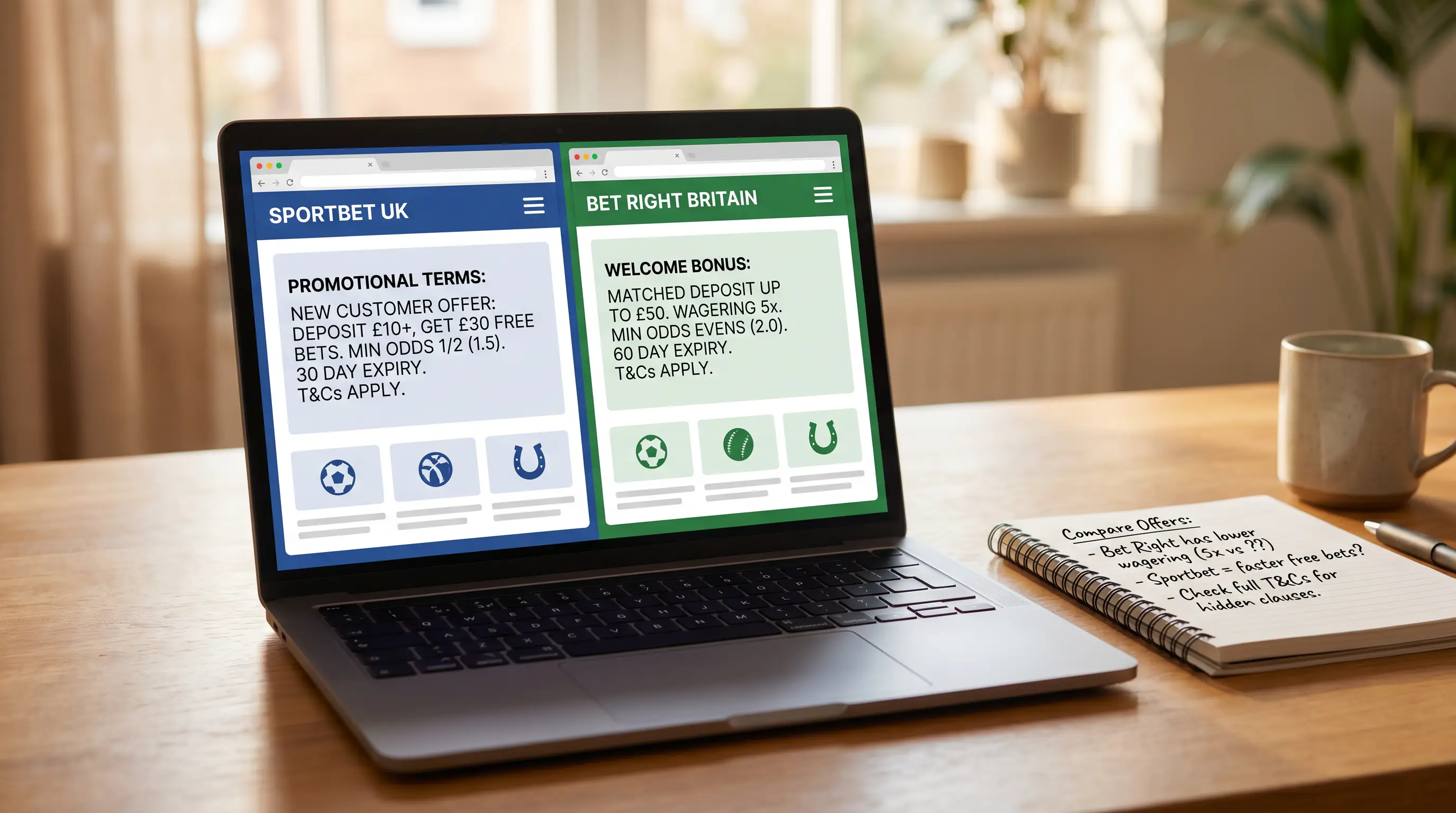
The first difference is which SP definition the operator uses. Some operators use the industry-standard Racing Post SP, others use their own internal SP calculated from their own market close. The difference is usually small but real — internal SPs sometimes settle longer than industry SPs because the operator’s own book sits at a slightly different point.
The second difference is whether BOG is automatic or opt-in. Most major UK operators apply BOG automatically to qualifying bets without any punter action required. A minority require the punter to opt in via a promotion code or settings toggle. Bets staked without the opt-in active don’t qualify, regardless of how clearly the promotion was advertised on the home page.
The third difference is maximum top-up cap. Some operators cap BOG top-ups at a stated amount per bet; others have no explicit cap on cricket markets. The capped operators are usually transparent about the limit in their terms, but punters with large stakes can be surprised when a long-priced winner pays the capped uplift rather than the full SP difference.
The William Hill brand alone captured 37.83 per cent of UK sports betting PPC clicks in early 2026, and the major operators between them dominate the BOG product space because the promotion is expensive to run at scale and only viable operators can absorb the cost. The smaller end of the market often advertises BOG-style upgrades but with significantly more restrictive terms.
When BOG Genuinely Helps a Cricket Punter
BOG adds real value in a narrow but consistent set of circumstances. It is most valuable on early-price markets where you’re confident the price will shorten by close — outright tournament backs early in the cycle, or pre-match match-winner takes on a fixture where you expect heavy late money on your side.

If a price is genuinely going to shorten, BOG doesn’t help you (the SP will be shorter than your taken price, and BOG pays the higher of the two — which is your taken price, settled normally). If a price is going to drift longer, BOG does help — you get paid at the longer SP.
The honest read on BOG is that it adds 1 to 3 per cent of expected value on average across qualifying bets, depending on how often you back drifters versus shorteners. That’s a real uplift but it’s not transformational. Roughly 78 per cent of UK sports betting now happens online, where BOG is most prominently marketed, and the promotion is competitive enough that most major operators offer it on similar terms. Treat it as a small, consistent edge enhancer rather than a primary reason to choose one sportsbook over another. The first filter on any sportsbook should always be licence verification — the UKGC licence check process covers that step in detail.
BOG Questions
Two operational questions about BOG come up most often.
Does BOG apply to in-play cricket markets?
No, at virtually every UK sportsbook. In-play markets are priced continuously throughout a match and don’t have a single official starting price against which BOG can be calculated. The promotion is typically restricted to pre-match markets that have a clean market close at the start of the relevant innings or match. A handful of operators offer separate live-betting promotions that function differently from BOG, but the standard BOG promise does not extend to in-play cricket lines at any major UK operator I’ve tested.
Is BOG paid in cash or free bet credit?
It varies by operator and sometimes by market. The default for major UK sportsbooks is to pay BOG top-ups as cash to your account balance, settled at the same time as the winning bet itself. A minority of operators pay BOG as free-bet credit, which has lower effective value because the stake portion of a free bet doesn’t return on winning bets. The terms and conditions of the specific BOG promotion are the only authoritative source on how the top-up is paid — read them before staking on the assumption that you’ll get a cash uplift, because that assumption is not universally true.
