
 Available in US
Content
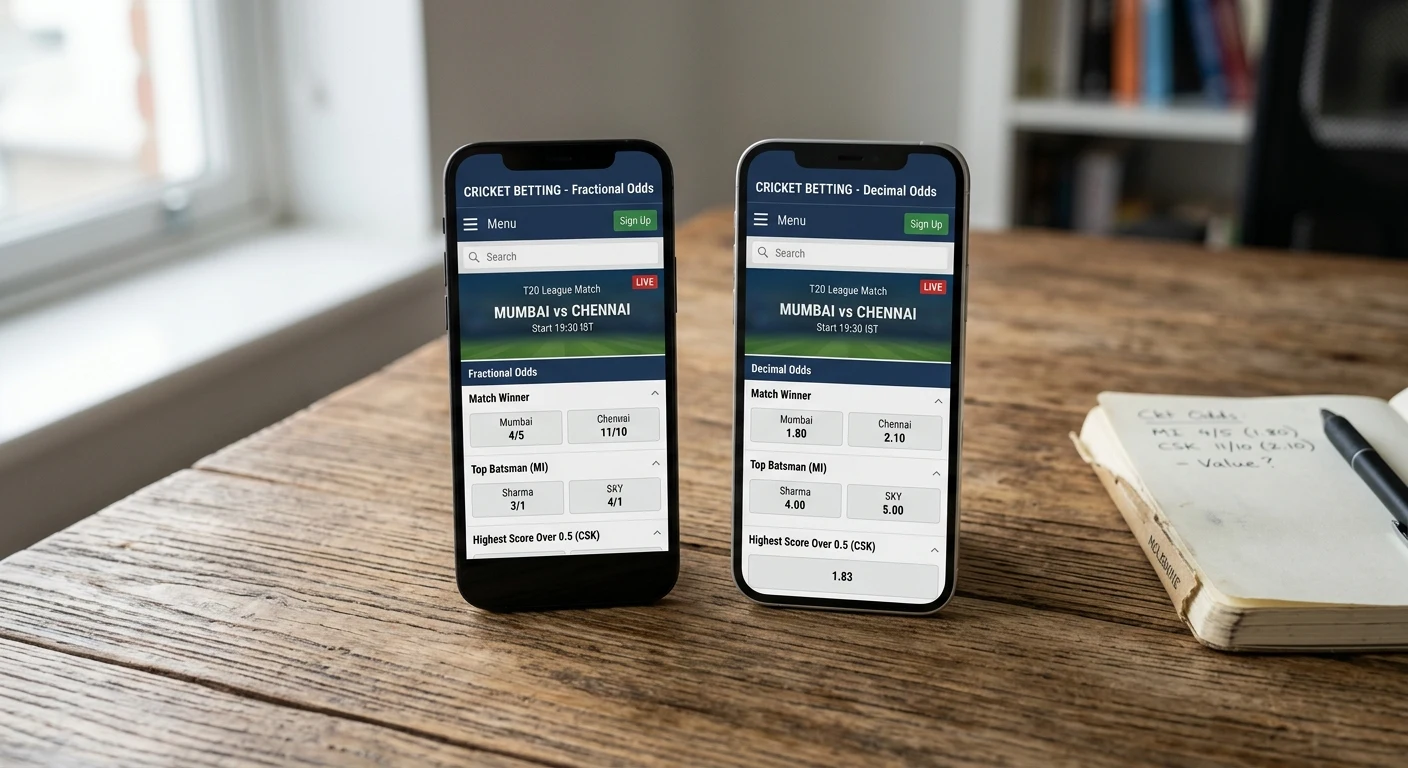
Two Numbers, One Bet: What Differs in the Display
I spend about half my analysis hours in spreadsheets that use decimal odds and about half on UK sportsbook websites that default to fractional. The friction of switching between the two used to slow me down. It doesn’t anymore, because I built a few mental shortcuts that I’ll share in this article — but the learning curve was longer than I thought it would be.
The two formats describe the same bet with the same return. Nothing about the underlying probability or the payout changes when a sportsbook flips between them. What changes is what the headline number represents. Fractional shows you the profit relative to your stake; decimal shows you the total return including your stake. Confusing those two definitions has cost more punters more money than any other single misunderstanding I’ve encountered.
Once you internalise which number represents what, the formats become interchangeable. The shortcuts in this article are designed to compress the conversion into something you can do in your head at the speed of a live betting slip.
Fractional Odds: The UK Default Explained
Every UK sportsbook I’ve used in nine years defaults to fractional odds on its cricket pages. It’s a cultural and regulatory inheritance from the on-course betting tradition, and it’s the format every UK casual punter knows even if they can’t explain it precisely.

A fractional price has a numerator and a denominator, separated by a forward slash. The numerator is the profit; the denominator is the stake required to win that profit. 5/2 means: stake two units, win five units profit, and you also get your two-unit stake back, for a total return of seven. 9/4 means: stake four units, win nine units profit. The shortcut is to divide the numerator by the denominator to get the profit-per-unit-staked figure — 5/2 is 2.5x your stake in profit, 9/4 is 2.25x.
The trap with fractional pricing is reading 11/10 as worse than evens. It isn’t — 11/10 means you win 1.1 units profit per unit staked, which is fractionally better than 1.0 units. A lot of new punters glance at 11/10 and think it’s longer than evens. It’s slightly shorter — the stake required is 10 to win 11, not 11 to win 10. Pace yourself on the small fractions, especially around the evens line, and the format becomes readable.
Decimal Odds: Stake-Inclusive Returns
Decimal odds are the European default and the format most analytical tools use internally. A decimal price is one number, usually to two decimal places, and it represents the total return per unit staked — including the stake itself.

2.50 in decimal means stake one unit, return 2.50 units total. That breaks down to 1.50 units profit plus the original one-unit stake. The conversion from fractional to decimal is straightforward: divide the numerator by the denominator and add one. 5/2 becomes 2.5 / 1 plus 1, which is 3.50. 9/4 becomes 2.25 plus 1, which is 3.25. Going the other way, subtract one from the decimal and find the closest fraction — 3.50 minus one is 2.5, which as a fraction is 5/2.
The advantage of decimal is that the maths is immediate. You don’t have to add the stake back into your head — the number on the screen already includes it. For spreadsheet work, model outputs and probability comparisons, decimal is the only sensible format. The disadvantage is that the prices look less granular at the long end. A 50/1 fractional price reads as 51.00 in decimal — accurate but unfamiliar to anyone who grew up with horse-racing pricing conventions.
Side-by-Side Conversion Worth Remembering
I keep a short list of conversion landmarks in my head, and these are the ones that come up most often on cricket slips.

1/4 in fractional is 1.25 in decimal — a very short price, often seen on heavy favourites in subcontinent T20 matches. 1/2 fractional is 1.50 decimal — the typical short-price favourite in a mismatched fixture. Evens, written as 1/1, is 2.00 decimal — the perfect mid-point and the cleanest reference price. 6/4 fractional is 2.50 decimal — a price you see often on the second-favourite in a tight T20. 2/1 fractional is 3.00 decimal — a clean conversion. 5/2 is 3.50. 3/1 is 4.00. 9/2 is 5.50. 5/1 is 6.00. 8/1 is 9.00. 10/1 is 11.00.
The pattern is “fractional plus one equals decimal” if you treat the fraction as a single number. 10/1 becomes 10 plus 1, which is 11.00. 6/4 is 6/4 plus 1, which is 1.5 plus 1, which is 2.50. Once that pattern clicks, the conversion stops being a separate calculation and becomes automatic.
The UK cricket betting market sees around 290 million online bets every month across all sports — a volume that means even a one-tick price difference between two formats can matter financially across a settlement run. Pricing engines internally calculate in decimal and convert to fractional for display. The fractional display is always rounded to the nearest standard fraction the book uses (1/4 increments below 1, 1/8 increments above), which is where small display gaps come from.
Cricket-Specific Edge Cases at Long Prices
The long end of the cricket book is where the two formats start to diverge in practical usability. At 50/1 fractional, the bookkeeper is offering you the same probability as 51.00 decimal — but on a 100/1 or longer outsider, the fractional displays start to look approximate while the decimals stay precise.

A 250/1 outright on a Caribbean Premier League dark horse looks neat as fractional, but the bookkeeper may have priced it internally as 246.50 or 253.00 decimal and rounded to the nearest 50/1 fractional tick. That rounding works in your favour at some prices and against you at others — and on the long end, it can amount to a couple of per cent of expected value.
The other cricket-specific edge case is the in-play repricing speed. T20 cricket prices update ball by ball during the powerplay, and the decimal numbers move with two-decimal-place precision while the fractional display ticks between standard increments. If you’re shopping the same price across two sportsbooks during a live powerplay, the decimal comparison is always more accurate than the fractional one. For converting prices into actionable forecasts, the probability-conversion framework is the natural next step.
Format-Switching Questions
Two specific questions about display conventions come up regularly when readers move between sportsbooks.

Are decimal odds rounded the same way at every UK sportsbook?
No, and the differences can be material at long prices. Most UK sportsbooks display decimals to two decimal places, but the underlying calculation may use three or four decimals. Operators differ in their rounding rules — some round to nearest, some always down, some apply different rounding above and below specific price thresholds. The display value is what settles your bet, so the rounded display is the contractual price. At evens or short prices the difference is negligible, but at 50.00 or longer, two operators showing the ‘same’ price can settle at materially different returns.
Why are some cricket prices shown only in decimal?
Highly granular in-play prices and exotic markets — especially partnership totals, session bets, and ball-by-ball next-event lines — are often shown only in decimal because the underlying calculation produces values that don’t round cleanly to standard fractional ticks. A price of 1.87 decimal cannot be displayed accurately as a fraction without rounding, and operators prefer to show the precise decimal rather than a misleadingly rounded fractional. Many UK sportsbooks allow you to set your default display preference in account settings, but exotic in-play markets may override that preference.
